
The European Commission has published a free set of icons for marking content that was generated or altered by AI. They are small, plain symbols you can drop onto an image, a video, or a page, and they exist to answer one question for a reader: was a person or a machine behind this?
The icons arrived alongside the transparency rules in the AI Act, which apply from 2 August 2026. Those two things are easy to confuse, so it is worth separating them straight away. Using the icons is optional. The labeling duty underneath them is not. And using an icon does not by itself prove that you have met the duty.
Most of the site owners we work with will find that this touches them less than the headlines suggest, and in a narrower place than they expect. Here is our read of it, and what we suggest you check.
What the icons actually are
There are three of them, and the distinction between them is useful in itself:
- A basic icon, for cases where AI was involved somewhere in the making of the content, paired with your own wording or an interactive layer that explains how.
- Fully AI-generated, for content created start to finish by a model, with no human-made element in it.
- Partially AI-modified, for something a person made that AI later altered.

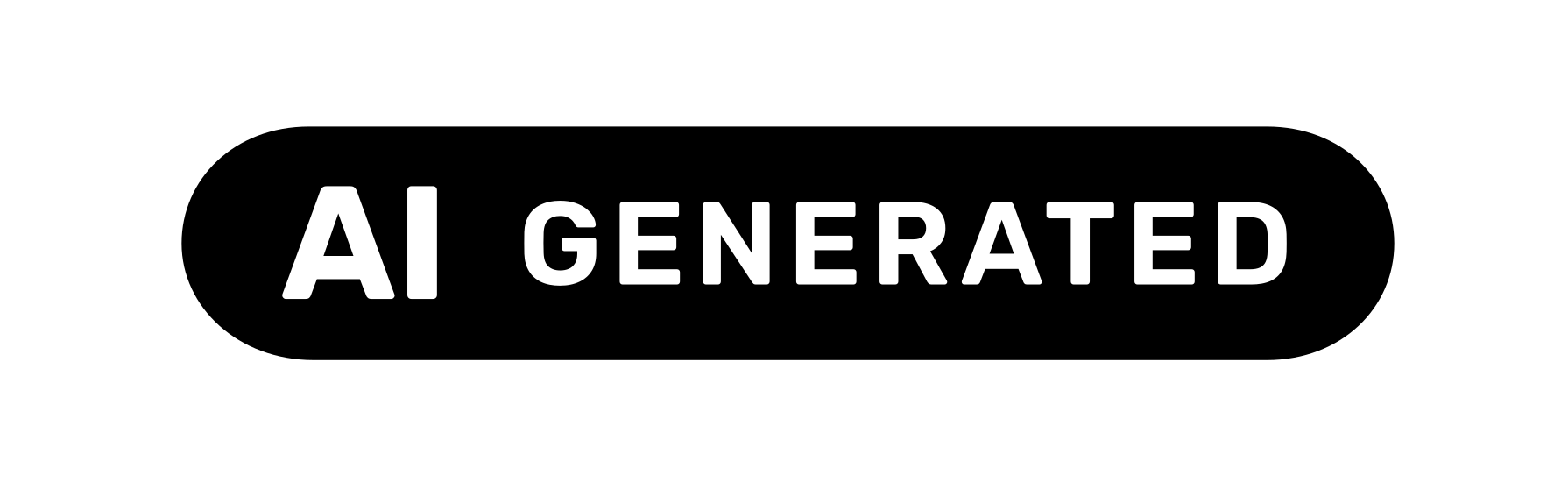
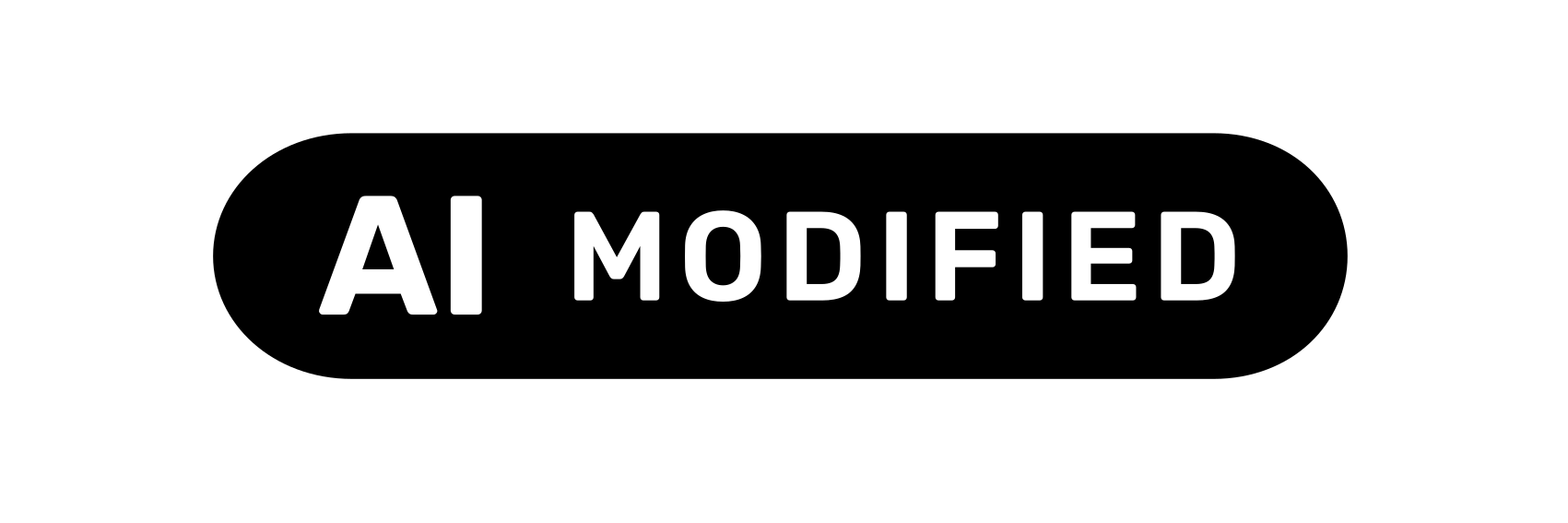
Each comes as black, white, and both again at 50 percent transparency, in SVG and PNG. They are free to download from the European Commission's icon page (direct downloads: SVG set, PNG set) and free to use, with no attribution required, which is genuinely helpful: it means a label on a Romanian site and a label on a German one can look the same, and a reader learns the symbol once.
The Commission also sets out how a label should behave when you use one. It should be noticeable the moment someone encounters the content, not buried in a caption further down. It should sit in the content itself where that is possible, so it survives being reshared or downloaded rather than living only in the page around it. And it should come with plain wording, because a symbol on its own leaves too much to guesswork.
The rule the icons serve
The transparency rules in Article 50 of the AI Act split by role, and the split matters. Some of the duties belong to the companies that build AI systems. Some belong to whoever publishes the output. If you run a website, you are almost always in the second group.
The part that lands on publishers covers two things. The first is deepfakes: image, audio, or video that resembles a real person, place, or event closely enough to pass as authentic. If you publish one, you disclose it.
The second is more likely to touch an ordinary business site. AI-generated or AI-altered text, published to inform the public on a matter of public interest, has to be labeled. The Commission reads that category broadly. It names politics and democratic processes, public administration and services, justice and law enforcement, fundamental rights, public security, public health, environmental protection, and consumer safety, and commentary since has noted that employment, health, financial, and legal communications can fall inside it too.
Alongside these, an AI system that talks directly to people needs to make clear it is an AI, unless that is already obvious. If you have added a chatbot to your site in the last couple of years, that is the line to check it against.
The exemption most sites will rely on
This is the part we would put in front of anyone reading about the new rules and wondering how much work is coming.
The text labeling duty falls away when the text has been through genuine human review, and a person or a company holds editorial responsibility for publishing it. That is the whole exemption, and for most business websites it is the answer. If a member of your team drafts an article with AI help, reads it properly, checks the facts and the sources, and publishes it under your name, you are not publishing unlabeled AI text. You are publishing your own text.
The qualifier is that the review has to be real. The guidance is explicit that a substantive examination by someone who knows the subject is what counts, and that a superficial pass is not the same thing. So the practical question is not really about AI at all. It is about whether your publishing process has a named person who reads what goes out and is accountable for it.
Where a label genuinely becomes necessary is the case the exemption does not cover: text that goes from a model to your live site without a person meaningfully in between. Automated topic pages, generated product or location descriptions at volume, feeds that publish on a schedule. If any of that touches the public-interest subjects above, that is where the icon earns its place.
Dates, and how firm they are
The obligations apply from 2 August 2026. There is one narrow extension: for AI systems already on the market before that date, the machine-readable marking duty applies from 2 December 2026 instead, which is a builder-side concern rather than a publisher one. Content published before the rules apply does not have to be labeled retroactively.
Enforcement sits with national market surveillance authorities, and the AI Act sets the ceiling for breaches of the transparency rules at 15 million euros or 3 percent of worldwide annual turnover, with proportionality written in for smaller companies. We mention the number for completeness rather than for effect. For a small or mid-sized business publishing reviewed content under its own name, the realistic task here is documentation, not remediation.
There is also a Code of Practice on transparency of AI-generated content, which providers and publishers can sign voluntarily. Signing shifts the conversation with regulators toward adherence to the code, which brings a degree of predictability. It is aimed mainly at the companies building and deploying generative systems at scale, so it is worth knowing about rather than something we would push a typical site owner toward.
What we suggest you check
Four things, in the order we would look at them.
Where AI enters your publishing. Not whether it does, because for most teams it now does somewhere. Where. Draft assistance inside an editorial workflow is a very different position from a generated page reaching the site unread, and the rules treat them differently.
Who holds editorial responsibility. Ideally this is a person, written down. It is the single answer that resolves most of the text question, and it is worth being able to state plainly rather than assume.
Your chatbot, if you have one. A short, visible line at the start of the conversation is usually all this needs.
AI imagery in campaigns. Generated visuals of people or places are the case most likely to need a label on an otherwise ordinary marketing site, and the one teams tend to overlook because the image looks harmless.
How we handle this side of a site
Two parts of what we already build turn out to fit this well, which is a nice outcome of decisions made for other reasons.
The first is the editorial workflow. Drupal gives you draft, review, and publish as real states with real permissions, and we set sites up so that content moves through a person before it goes live. That structure is what the exemption is describing. When a client asks us to evidence their process, we can point at the workflow and the revision history rather than at a policy document, and revision history shows who reviewed what and when.
The second is that a label is a content field, not a sticker. When AI involvement needs disclosing, we prefer to model it: a field on the content type, rendered by a component, so the icon and its wording appear in the same place every time, in every language on the site, and travel with the content into feeds and social cards. That is the difference between a label that holds up and one an editor has to remember to paste in.
We also apply the same thinking to our own work. AI helps us draft and research, and every change still goes through review by a person who is accountable for it. It would be a strange position to hold for ourselves and not for the sites we build.
The broader point
Reading through the Commission material, what stands out is how much of this is a workflow question dressed as a technology question. The icons are a nice piece of design, and standard symbols across the single market are worth having. But the substance of the rule asks something simpler: is a person accountable for what your site publishes, and can you show it?
That was worth being able to answer before August 2026, and it stays worth answering afterward. Readers are getting better at wondering where text came from, and being straightforward about it is the kind of thing that earns trust slowly and keeps it. If you want a look at where AI sits in your publishing today and what, if anything, needs a label, that is a short conversation and we are happy to have it.